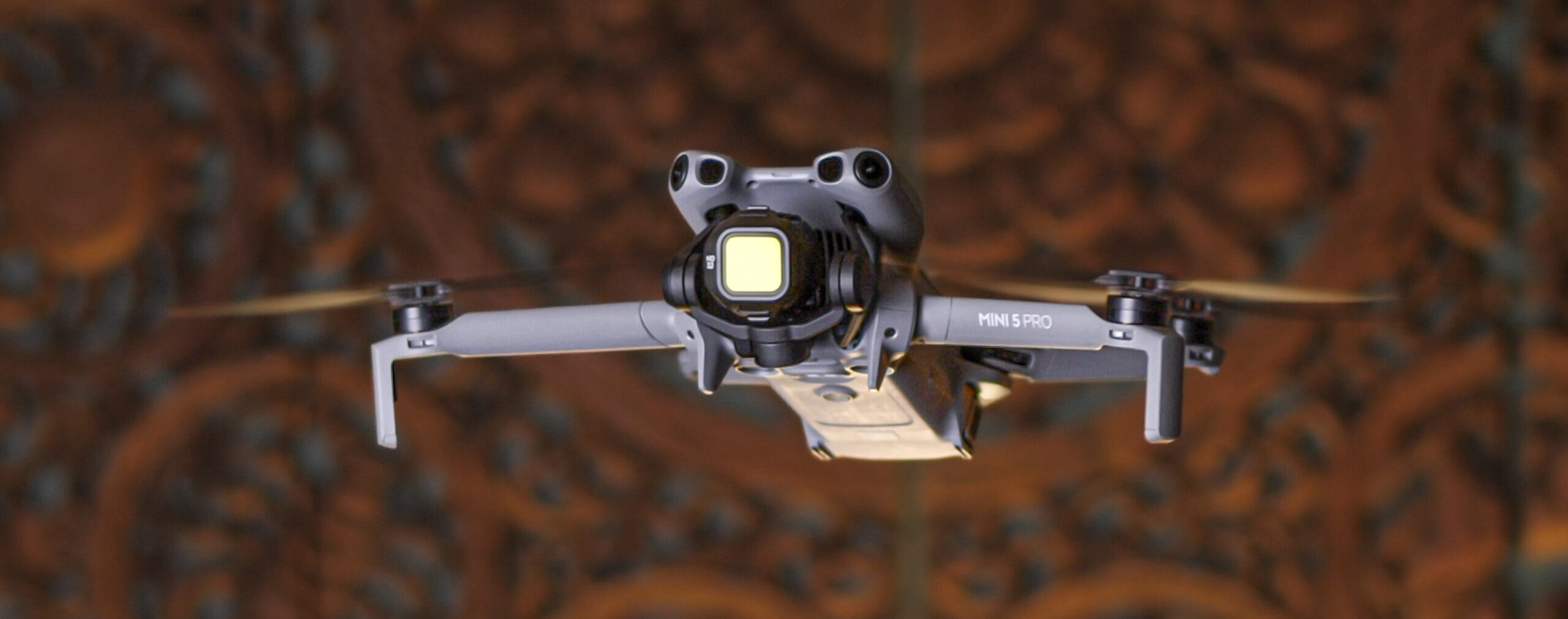
DJI Mini 5 Pro – A Compact Drone That Feels Closer Than Ever to a Real Camera
At first glance, the Mini 5 Pro looks like a natural evolution of what DJI has already been doing so well. The DJI Mini 3 Pro and DJI Mini 4 Pro were already incredibly capable drones, delivering impressive image quality in a compact form.
But once you start using the Mini 5 Pro, you notice a shift. It’s not that previous Minis weren’t good enough – far from it. It’s that this one gives you a bit more freedom, a bit more flexibility, and a bit more confidence when shooting in real-world conditions.
And that subtle difference has a big impact on how you approach your shots.
10 steps to create stunning footage with any camera?
Our Quick Verdict
The Mini 5 Pro builds on what made previous Mini drones so good, but refines the experience in ways that genuinely matter when you’re shooting.
The image holds together better in difficult light, the 2× zoom adds real creative flexibility, and the overall shooting experience feels faster and more effortless.
The combination of imaging quality, size/weight, DJI’s established tracking and autonomous flight technology, flight time etc., makes the Mini 5 Pro a standout drone in DJI’s lineup.
Mini 5 Pro – Key Specs
- 🟡 Weight: < 250g
No registration in many regions, huge usability advantage - 🟡 Sensor: 1-inch CMOS / 50MP effective pixels
Major upgrade in image quality, especially in dynamic range and low light - 🟡 Video: 4K up to 100fps / HDR video
Flexible for both cinematic shooting and slow motion - 🟡 Colour: 10-bit D-Log M + Fusion HDR
Strong grading flexibility + impressive straight-out-of-camera results - 🟡 Zoom: 2x digital zoom (virtually lossless)
Acts like a second focal length in real-world use
- 🟡 Stabilisation: 3-axis mechanical gimbal
Smooth, reliable footage in most conditions - 🟡 Flight time: 36 minutes (rated)
Real-world: lower, but still very usable - 🟡 Transmission: O4+ (rated for 20km FCC / 10km CE)
Extremely reliable signal and confidence when flying - 🟡 Storage: 42GB Internal storage + microSD
Useful backup if you forget a card - 🟡 Obstacle sensing: Omnidirectional
Strong safety and tracking reliability
✅ What it does well
- Delivers a more flexible, forgiving image in real-world conditions
The dynamic range improvements are noticeable, but more importantly, they’re usable. You can protect highlights, lift shadows, and the footage holds together better without needing to fight it in post. - Fusion HDR produces a natural, balanced result
Compared to earlier implementations like the DJI Mavic Air 2, HDR here feels far more refined. It helps manage contrast without creating that overly processed or artificial look. - The 2× zoom adds genuine creative value
Regardless of how it’s achieved technically, it works. It gives you a second focal length that opens up compositions, simplifies scenes, and lets you capture shots that would otherwise require repositioning the drone. - Fast deployment encourages you to shoot more often
The instant-on behaviour when unfolding the drone makes a real difference. It reduces friction and makes it easier to capture moments quickly. - Quiet, compact, and easy to carry everywhere
It’s a drone you’ll actually take with you. The size, weight, and relatively low noise make it far more practical for everyday use. - Strong wind resistance for its size
Despite being under 250g, it feels stable and reliable in conditions where you might expect smaller drones to struggle. - Reliable, confidence-inspiring transmission
DJI’s OcuSync system delivers a stable connection and dependable live view, allowing you to focus on the shot rather than the signal.
❌ Where it falls short
- The 2× zoom isn’t identical to the main camera
It’s excellent and very usable, but it still relies on cropping and processing, so you may notice differences in more challenging lighting or higher ISO situations. - Larger drones still have the edge in extreme conditions
While this is a big step forward, drones with larger sensors will still perform better in very low light or the most demanding dynamic range scenarios. - Sits at the premium end of the Mini category
It’s not the cheapest way to get into drone filmmaking, so you need to value the improvements in image quality and usability to justify the price.
✅ Who it’s for
- Creators who want high-end image quality without moving up to a larger drone
If you care about how your footage holds up in real-world conditions, this gives you more confidence without sacrificing portability. - Anyone regularly shooting in challenging light
Backlit scenes, sunsets, and high-contrast environments are much easier to manage with the added flexibility in the image. - Filmmakers who value composition and storytelling over pure specs
The addition of the 2× zoom and improved image handling gives you more creative control without complicating the process. - People who want a drone they’ll actually carry and use
The size, weight, and fast deployment make it easy to integrate into everyday shooting.
❌ Who it’s not for
- Budget-focused buyers looking for the lowest-cost entry point
There are more affordable options that still deliver strong results, including the DJI Neo 2. - Casual users who won’t take advantage of the image improvements
If you’re not pushing the camera or shooting in more demanding conditions, you may not see the full benefit. - Anyone expecting it to completely replace larger sensor drones
It’s incredibly capable for its size, but there are still scenarios where bigger systems have an advantage.
Create Better Footage Faster
If you want more cinematic results from any drone or camera, download our free Creator’s Cheat Code. It gives you 10 practical triggers you can use immediately to improve your shots.

WHAT MAKES THE mini 5 pro DIFFERENT?
Most Mini drones have always struck a balance between portability and performance. The DJI Mini 3 Pro and DJI Mini 4 Pro already delivered excellent results, with a 1/1.3-inch sensor, 10-bit D-Log M, and strong HDR capabilities.
The Mini 5 Pro builds on that foundation with a larger 1-inch sensor, improved dynamic range (around 14 stops), and more advanced HDR processing. It doesn’t remove the need to think about exposure but it gives you more headroom. Highlights roll off more smoothly, shadows hold together better, and the image is generally more forgiving when conditions aren’t ideal.
It also introduces a more usable 2× zoom (approximately a 48mm equivalent), giving you a second focal length for composition, alongside faster deployment and a more streamlined shooting experience overall.
The result is not a completely different drone – but one that offers more flexibility, more consistency, and a bit more confidence when you’re pushing the camera in real-world situations.
DJI Mini 5 Pro vs DJI Mini 4 Pro
🟢 The key differences (that actually matter)
- Stronger, more flexible image in difficult light
The Mini 4 Pro already delivered great results, but the Mini 5 Pro holds onto highlights better and gives you more room to work with in the shadows. It’s not about specs – it’s about how much more forgiving the image feels in real-world conditions. - A more usable 2× zoom
Both drones offer a cropped zoom, but the Mini 5 Pro makes it far more practical. It feels closer to a second focal length, and you’ll find yourself using it regularly rather than treating it as a backup option. - More natural HDR and colour handling
HDR on the Mini 4 Pro was solid, but the Mini 5 Pro refines it. The result is a more balanced image that requires less correction in post and feels more natural straight out of camera. - Better low-light performance
The Mini 5 Pro handles noise more effectively and produces cleaner shadows, giving you more confidence when shooting later in the day or in more challenging lighting. - Quieter, more refined overall experience
It’s a small detail, but it matters. The Mini 5 Pro is less intrusive and feels more polished in everyday use. - Faster, more seamless workflow
The instant-on deployment and general responsiveness make it easier to capture shots quickly, which changes how often you actually use the drone.
🔴 What hasn’t really changed
- Core flying experience and form factor
Both drones are compact, lightweight, and easy to carry. - Overall capability level
The Mini 4 Pro is still a very capable camera drone. This isn’t a case of “old vs obsolete.” - Creative potential
You can still achieve excellent results with either drone – the Mini 5 Pro just makes it easier and more consistent.
🤷 Should you upgrade?
- Upgrade if you want more confidence in your footage
If you regularly shoot in challenging light or want a more forgiving image, the Mini 5 Pro is a meaningful step forward. - Upgrade if you value speed and ease of use
The faster deployment and smoother workflow make a bigger difference than you might expect. - Stick with the Mini 4 Pro if you’re happy with your results
If your current setup is working for you and you’re not pushing its limits, there’s no urgent need to upgrade.
Is the DJI Mini 5 Pro Worth It?
If you already own a recent Mini drone and are happy with the results, this isn’t about fixing a broken system. But if you want a bit more confidence in your footage, a bit more creative flexibility, and a smoother overall shooting experience, the Mini 5 Pro delivers that.
If you are looking for a cheaper drone with multiple control options that is best suited for beginners, check out the DJI Neo 2:
Check Price & Availability
If you’re considering the DJI Mini 5 Pro, you can check the latest price and availability here:
We may earn a small commission at no extra cost to you.
Related Resources
Explore our most popular free guides to improve your footage: