DJI Mavic 4 Pro – A Flagship Drone Focused on Reliability and Image Quality
At first glance, the DJI Mavic 4 Pro follows a familiar direction for DJI’s flagship drones. It builds on the same core ideas as previous models – larger sensors, multiple focal lengths, and a strong emphasis on flight performance.
In use, the key difference is consistency. This is a drone that continues to perform in situations where smaller or lighter systems start to struggle – particularly in wind, changing light, or time-sensitive scenarios.
From our own experience filming weddings, commercial work, and music videos, those conditions are often the norm rather than the exception. You don’t always have the option to wait or come back later. In that context, the Mavic 4 Pro is designed as a dependable working tool rather than a convenience-focused product.
Watch Our DJI Mavic 4 Pro Review
A high-end system designed for demanding shooting conditions, where consistency and control matter more than convenience.
want shots like this with any camera?
Our Quick Verdict
The Mavic 4 Pro is a highly capable drone with a clear emphasis on image quality and flight stability. The Four Thirds Hasselblad camera delivers strong results, the variable aperture adds practical flexibility, and the overall flight performance is well suited to more demanding conditions.
The triple-camera system expands creative options, but it also introduces additional complexity that needs to be managed in practice. Overall, it is best understood as a professional tool rather than a general-purpose drone.
MAVIC 4 PRO – KEY SPECS
- 🟡 Weight: 1063g
Class C2 (EU) / registration required in most regions - 🟡 Main Camera: 4/3 CMOS Hasselblad sensor (100MP)
28mm equivalent focal length
Variable aperture: f/2.0 – f/11 - 🟡 Medium Tele Camera: 1/1.3-inch CMOS sensor (48MP)
70mm equivalent focal length
Fixed aperture: f/2.8 - 🟡 Tele Camera: 1/1.5-inch CMOS sensor (50MP)
168mm equivalent focal length
Fixed aperture: f/2.8 - 🟡 Video (Main Camera):
Up to 6K at 60fps
4K up to 120fps - 🟡 Video (Tele Cameras):
Up to 4K at 120fps
- 🟡 Colour Profiles:
10-bit D-Log / HLG across all three cameras
Hasselblad Natural Colour Solution (HNCS) on main camera - 🟡 Stabilisation: 3-axis mechanical gimbal
- 🟡 Flight time: Up to 51 minutes (rated)
- 🟡 Transmission: O4+
Up to 15km (CE) / 30km (FCC) rated range - 🟡 Storage: Internal storage – 64GB / 512GB (creator combo)
- 🟡 Obstacle sensing: Omnidirectional obstacle sensing + forward-facing LiDAR sensor
- 🟡 Max wind resistance: 12 m/s (level 5)
✅ What it does well
- Strong image quality from the main camera: The Four Thirds sensor provides excellent dynamic range and colour depth, with footage that holds up well in high-contrast situations and during post-processing.
- Variable aperture improves exposure control: The adjustable aperture allows exposure to be managed without relying entirely on ND filters. This is particularly useful when light levels change during a flight.
- Multiple focal lengths offer compositional flexibility: The three-camera setup allows you to change perspective without repositioning the drone, which can be useful in structured shooting environments.
- Stable and predictable flight performance: The drone handles wind well and maintains consistent positioning, which is important when working in less controlled conditions.
- Extended flight times: Longer battery life reduces interruptions and allows more time to work through a shot or sequence.
- Reliable transmission system: The connection remains stable over distance, with a dependable live view that supports more precise framing.
- Suitable for professional workflows: The combination of image quality, flight stability, and control options makes it appropriate for commercial use cases where reliability is important.
❌ Where it falls short
- High cost relative to alternatives: With drones like the DJI Mini 5 Pro and DJI Air 3S offering strong performance at lower price points, the difference in cost is significant.
- Camera switching is not seamless: Each camera has different characteristics, including sensor size and aperture, which affects exposure and overall image consistency when switching between them.
- Increased complexity in practice: Using multiple cameras requires more active management of settings, including ND filters and exposure adjustments.
- Inconsistent imaging across lenses: Although all cameras support similar recording formats, they do not produce identical results. Matching footage between lenses may require additional work in post.
✅ Who it’s for
- Professional and commercial shooters: Those working in environments where conditions cannot be controlled or repeated will benefit most from the added stability and performance.
- Projects that require consistent results: Situations such as weddings, events, or client work, where reliability is more important than portability.
- Users who prioritise image quality: The larger sensor and overall imaging system provide advantages over smaller drones in more demanding scenarios.
- Filmmakers who use multiple focal lengths deliberately: The additional cameras are most useful when they are part of a considered shooting approach, rather than occasional use.
❌ Who it’s not for
- Casual users or occasional flyers: For general use, the size, cost, and complexity are difficult to justify.
- Those prioritising simplicity: Single-camera systems offer a more straightforward and consistent shooting experience.
- Budget-conscious buyers: There are more affordable drones that provide strong results without the same level of investment.
- Users who do not regularly shoot in challenging conditions: If you are not working in situations where reliability is critical, many of the advantages will be less noticeable.
WHAT MAKES THE MAVIC 4 PRO DIFFERENT?
Most drones are designed around a balance of portability, cost, and performance. The Mavic 4 Pro places more emphasis on performance and consistency.
This is reflected in:
- The larger sensor
- The variable aperture
- The overall flight stability
- The multi-camera configuration
The result is a system that is better suited to structured, outcome-focused shooting rather than casual use.
A note on the triple-camera design
The three-camera system provides flexibility, but it is important to understand how it behaves in practice. These are three different cameras, not a single system with continuous zoom. As a result, there are differences in:
- Sensor size
- Aperture
- Exposure behaviour
- ND filter requirements
From a practical standpoint, this means that switching between lenses requires adjustment rather than being completely seamless. An alternative approach, for example, a single larger sensor with optical zoom, would offer greater consistency, although with less range in focal lengths.
The current design prioritises flexibility, but with added workflow considerations.
Is the DJI MAVIC 4 PRO Worth It?
For professional use in demanding conditions, it is a capable and reliable system. For many other use cases, smaller and more affordable drones will be sufficient. The value depends largely on how important consistency and performance are within your specific workflow.
If the Mavic 4 Pro is a little overqualified for your needs, check out the Mini 5 Pro:
Create Better Footage Faster
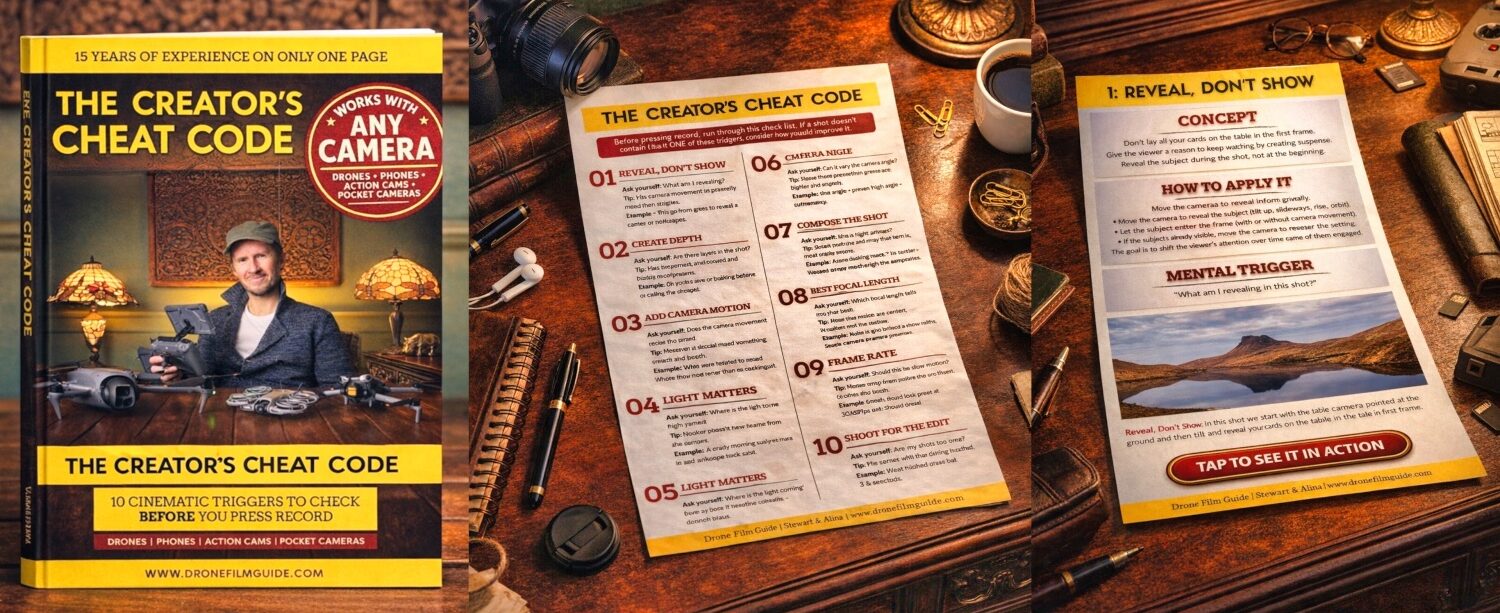
If you want more cinematic results from any drone or camera, download our free Creator’s Cheat Code. It gives you 10 practical triggers you can use immediately to improve your shots.
Check Price & Availability
If you’re considering the DJI Flip, you can check the latest price and availability here:
We may earn a small commission at no extra cost to you.
Related Resources
Explore our most popular free guides to improve your footage: